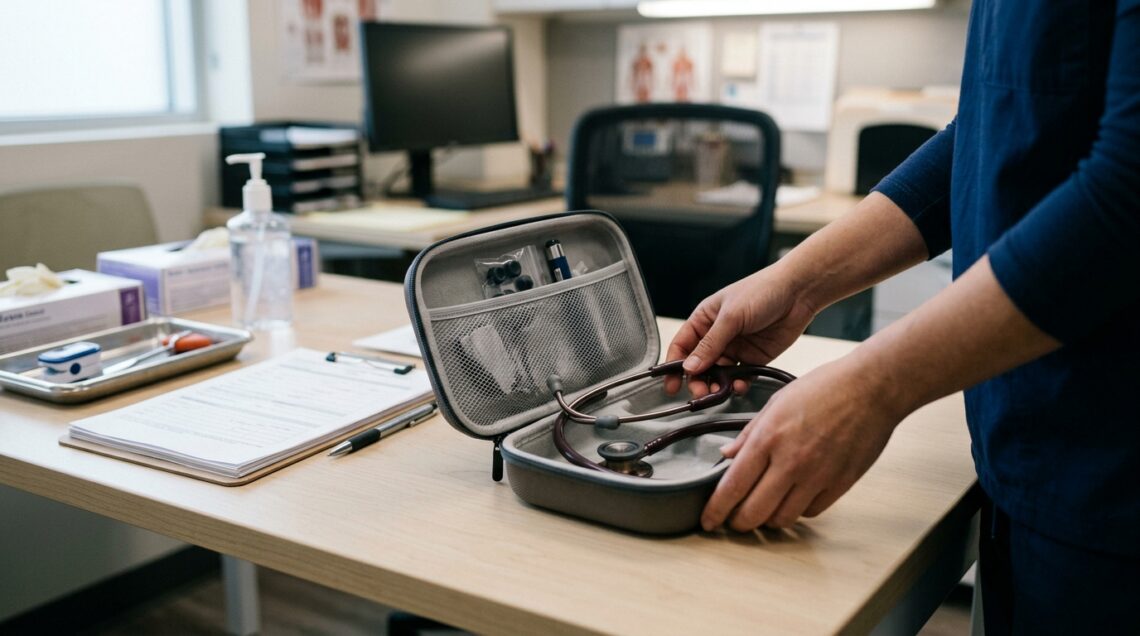
A stethoscope is one of the most familiar tools used by nurses, physicians, medical assistants, healthcare students, veterinary teams, and other clinical workers. Because it may move between bags, lockers, classrooms, exam rooms, vehicles, and workstations, daily storage matters more than many people realize.
A good stethoscope carrying case helps protect the instrument from scratches, bending, clutter, and accidental damage while keeping related accessories easier to find. For healthcare workers and students, the right case can make daily routines more organized, especially when moving between shifts, clinics, labs, and clinical rotations.
Quick Answer
A stethoscope case is useful for protecting a stethoscope during transport, keeping small accessories organized, and reducing loose storage inside scrub bags or backpacks. Buyers should look for a case with the right size, semi-rigid protection, secure zipper, clean interior layout, accessory pockets, easy-carry design, and material that fits daily healthcare routines.
Healthcare workers choosing a stethoscope case should review:
- Case size and stethoscope fit
- Semi-rigid or soft-shell protection
- Zipper strength
- Interior shape and padding
- Accessory mesh pockets
- Penlight or small tool storage
- Easy-clean material
- Bag and backpack compatibility
- Lightweight design
- Durability for daily commuting
- School or workplace storage needs
- Return or exchange policy before buying
Why Stethoscope Cases Matter
A stethoscope is often carried with pens, notebooks, snacks, chargers, badges, scrub jackets, water bottles, and other shift essentials. Without a dedicated case, it can become tangled, compressed, scratched, or buried inside a bag.
A stethoscope case can help with:
- Protecting tubing from unnecessary bending
- Keeping the chestpiece from scratching other items
- Reducing clutter in scrub bags
- Storing small accessories in one place
- Supporting school and clinical rotation routines
- Keeping tools easier to locate before a shift
- Separating a stethoscope from loose personal items
- Helping the bag stay more organized
A case does not replace proper cleaning or workplace policy, but it can support better day-to-day storage habits.
Protection Is the Main Purpose
The main reason to use a stethoscope case is protection. A stethoscope placed loose in a bag may press against books, laptops, water bottles, shoes, food containers, or other items. Over time, careless storage may make the instrument harder to keep organized and easier to damage.
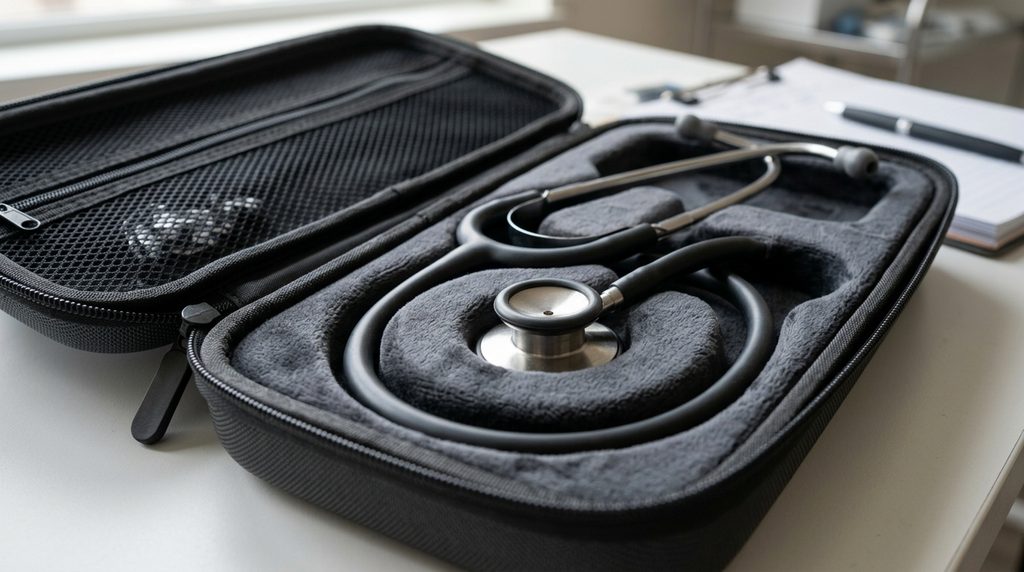
A protective case may help reduce:
- Scratches on the chestpiece
- Tangled tubing
- Pressure from heavy items
- Loose storage in backpacks
- Contact with pens or sharp objects
- Misplacement during commuting
- Damage during school or clinical rotations
- Bag clutter during long shifts
Workers comparing the best stethoscope case should focus first on fit and protection, not only color or style.
Case Size Should Fit the Stethoscope Properly
A case should be large enough to hold the stethoscope without forcing it into an awkward shape. If the case is too small, the tubing may bend sharply or feel compressed. If the case is too large, the stethoscope may shift around too much.
Healthcare workers should check:
- Interior length and width
- Depth of the case
- Whether the tubing fits naturally
- Whether the chestpiece has enough room
- Whether earpieces sit comfortably
- Whether accessories fit without crowding
- Whether the case still closes easily
- Whether the case fits inside a scrub bag or backpack
The right case should protect the stethoscope without forcing the instrument into a tight or unnatural position.
Semi-Rigid Cases Offer Added Protection
Stethoscope cases may be soft, semi-rigid, or hard-shell. Each style has different benefits. Soft cases are usually lighter and more flexible, while semi-rigid cases offer more structure and protection from pressure inside a bag.
Soft stethoscope cases
Soft cases may work well for workers who carry light bags and want a flexible storage option. They may fit easily into totes, backpacks, and lockers.
Semi-rigid stethoscope cases
Semi-rigid cases can offer a better balance of structure and portability. They may help protect the stethoscope from being compressed by books, shoes, lunch containers, or other bag contents.
Hard-shell cases
Hard-shell cases may offer stronger protection, but they can be bulkier. Workers should check whether the case fits inside their daily work bag.
The best option depends on how the stethoscope is carried and how much protection is needed.
Zipper Quality Matters
A case is only useful if it opens and closes reliably. A weak zipper can become frustrating quickly, especially during busy mornings, clinical rotations, or shift changes.
Before buying, healthcare workers should check:
- Smooth zipper movement
- Strong zipper track
- Pull tab comfort
- Whether the zipper catches fabric
- Whether the case closes without forcing
- Whether the zipper can handle daily use
- Whether the case opens wide enough for easy access
A durable zipper helps the case remain practical after repeated use.
Interior Layout Should Be Simple and Useful
The inside of a stethoscope case should make storage easier, not more complicated. A good layout should hold the stethoscope securely while offering small pockets for related accessories.
Helpful interior features may include:
- Mesh pocket
- Elastic strap
- Small divider
- Penlight storage
- Accessory sleeve
- Space for ear tips
- Space for ID tags
- Small tool pocket
- Soft lining
- Easy-view interior layout
Too many compartments can make the case bulky. Too few compartments may make accessories hard to find. The best layout depends on the worker’s daily routine.
Accessory Storage Can Reduce Bag Clutter
A stethoscope case can also store small clinical or school items. This can be helpful for nursing students, medical assistants, and workers who carry several small tools.
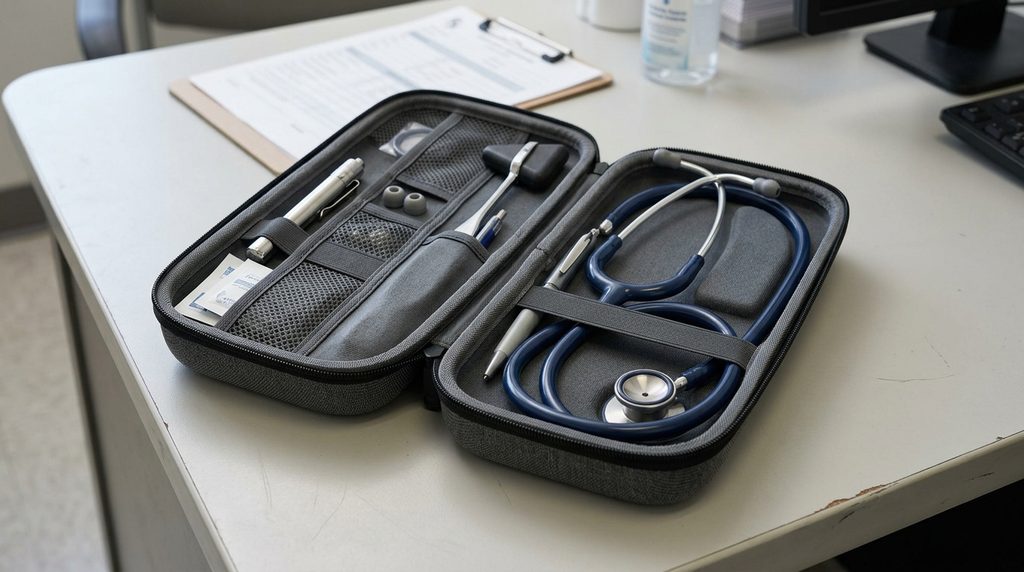
A case may hold:
- Extra ear tips
- Name tag or ID accessory
- Penlight
- Small scissors
- Alcohol prep pads, if allowed
- Small notepad
- Clinical reference card
- Extra pen
- Small badge accessory
- Small cleaning item, if permitted by policy
Workers should avoid overpacking the case. The main priority should be protecting the stethoscope and keeping small accessories organized.
Cleaning and Facility Policy Should Be Followed
A stethoscope case can help with storage, but it does not replace proper equipment cleaning. Healthcare workers should follow employer policy, manufacturer instructions, and facility expectations for cleaning stethoscopes and accessories.
The CDC explains that Standard Precautions are used for all patient care and include infection-prevention practices across healthcare settings. CDC guidance on disinfection and sterilization also provides broader context for cleaning and disinfection practices.
For daily use, workers should confirm:
- How the stethoscope should be cleaned
- Whether the case can be wiped
- Where personal equipment should be stored
- Whether the case can enter clinical areas
- Whether school or workplace rules apply
- Whether accessories should be stored separately
- Whether the case material has special care instructions
Policies can vary by workplace, school, department, and role.
Easy-Clean Materials Are Practical
A stethoscope case may be placed in lockers, backpacks, cars, classrooms, break rooms, or work bags. Materials that are easier to wipe or maintain can be more practical than fabrics that stain easily or collect lint.
Healthcare workers should consider:
- Smooth exterior material
- Durable interior lining
- Wipeable surface
- Stain resistance
- Odor resistance
- Darker or practical colors
- Whether the case attracts lint
- Whether the case can air out
- Whether cleaning instructions are realistic
A case should be easy to maintain as part of normal work and school routines.
Case Shape Affects Storage
The shape of the case affects how easily it fits in a bag, backpack, locker, or tote. Some cases are rounded or oval. Others are longer, flatter, or more structured.
Workers should check:
- Whether the case fits inside the daily bag
- Whether it fits in a locker
- Whether it takes up too much space
- Whether the shape protects the stethoscope
- Whether it stacks well with books or notebooks
- Whether it is easy to grab quickly
- Whether it fits with other shift essentials
A case that is too bulky may be left at home. A case that is too small may not protect the stethoscope properly.
Stethoscope Cases for Nursing Students
Nursing students often carry stethoscopes between classrooms, labs, simulation spaces, clinical rotations, and home. Because students may also carry laptops, notebooks, textbooks, water bottles, and uniforms, a case can help keep the stethoscope protected inside a crowded bag.

A student-friendly stethoscope case should offer:
- Lightweight protection
- Secure zipper
- Space for small accessories
- Backpack compatibility
- Easy-clean material
- Compact shape
- Simple organization
- Durable daily-use construction
Students should also check program requirements and clinical site rules for equipment storage and use.
Stethoscope Cases for Nurses
Nurses may use a stethoscope case to keep equipment organized between shifts, especially when commuting, changing units, or carrying a larger scrub bag.
A nurse-friendly case may need:
- Quick access
- Durable zipper
- Semi-rigid protection
- Accessory storage
- Easy-clean exterior
- Compact bag fit
- Space for small clinical items
- Lightweight carry design
Nurses working long shifts may benefit from a case that fits well inside a scrub bag without taking up too much space.
Stethoscope Cases for Medical Assistants and Clinic Staff
Medical assistants and clinic workers may move between exam rooms, intake areas, supply rooms, and front-desk tasks. A stethoscope case can help keep tools organized when moving between work and home.
Helpful features may include:
- Compact size
- Simple pocket layout
- Durable exterior
- Easy storage inside a tote or backpack
- Space for a penlight or small notes
- Smooth zipper
- Lightweight structure
A smaller case may be enough for workers who carry fewer accessories.
Stethoscope Cases for Veterinary and Dental Workers
Veterinary and dental teams may have different storage needs depending on role, equipment use, and workspace. Veterinary workers may want durable cases that are easy to clean and do not collect hair heavily. Dental workers may prefer compact storage that fits inside smaller work bags.
Useful features may include:
- Wipeable exterior
- Secure zipper
- Compact design
- Small accessory pocket
- Durable lining
- Lightweight carry
- Bag-friendly shape
- Easy separation from personal items
The right case should match the worker’s environment and how often the stethoscope is transported.
Stethoscope Cases vs Scrub Bags
A stethoscope case and scrub bag serve different purposes. A scrub bag holds many workday items, while a stethoscope case protects one important tool inside that larger system.
Stethoscope cases
Stethoscope cases help protect and organize the stethoscope and small accessories. They are useful for keeping the instrument from getting tangled or buried.
Scrub bags
Scrub bags hold broader daily essentials, including uniforms, jackets, shoes, snacks, water bottles, notebooks, and personal items.
Many workers use both. The stethoscope case keeps the instrument protected, while the scrub bag carries the full daily routine.
What to Avoid in a Stethoscope Case
Not every case is practical for healthcare use. Some cases look useful but may fail during daily storage and commuting.
Common issues include:
- Case too small for the stethoscope
- Weak zipper
- Poor interior layout
- No accessory pocket
- Bulky shape
- Hard-to-clean material
- Thin fabric with little protection
- Interior that catches tubing
- Case that does not fit in the daily bag
- Shell too rigid for locker storage
- No room for small accessories
A good case should protect the stethoscope without creating extra inconvenience.
Local Shopping Can Help With Fit and Size
Stethoscope case size can be hard to judge from photos alone. Trying one in person can help healthcare workers confirm whether the case fits the stethoscope, accessories, and daily bag.
Healthcare workers can review a stethoscope case near me option online, then compare size, structure, and pocket layout before purchasing.
A local fit check can help with:
- Confirming interior size
- Checking zipper quality
- Testing case structure
- Comparing soft and semi-rigid styles
- Seeing accessory pockets
- Checking bag compatibility
- Reviewing material feel
- Avoiding oversized cases
A case should work with the actual stethoscope and the actual bag used for work or school.
Team and Student Program Planning
Some healthcare programs, student groups, or teams may recommend stethoscope cases as part of an organized clinical setup. A case can be especially helpful when multiple students or staff members transport similar equipment.
Group buyers should consider:
- Stethoscope fit
- Case size
- Color options
- Labeling needs
- Student name identification
- Accessory storage
- Durability
- Cleaning expectations
- Reorder availability
- Return or exchange policy
A consistent storage system can help students and workers keep clinical tools easier to manage.
How to Pack a Stethoscope Case
A stethoscope case should be packed in a way that protects the instrument and keeps accessories from pressing against sensitive areas.
Helpful packing habits include:
- Place the stethoscope in the main shaped section
- Avoid sharp bends in the tubing
- Keep small accessories in mesh pockets
- Avoid overfilling the case
- Keep pens or tools from pressing into tubing
- Close the zipper gently
- Store the case in a stable area of the bag
- Avoid placing heavy items on top when possible
A simple packing routine can help the case stay useful day after day.
Care and Maintenance Should Be Reviewed
Stethoscope cases may be used frequently, so care and maintenance matter. Workers should review instructions before buying and build the case into normal organization habits.
Before buying, check:
- Whether the exterior can be wiped
- Whether the inside can be cleaned
- Whether the zipper feels durable
- Whether the case can air out
- Whether the lining holds lint
- Whether the case keeps shape
- Whether pockets stretch out
- Whether the shell cracks or collapses easily
- Whether the case fits in the daily bag after packing
A case that is difficult to maintain may not be practical for regular healthcare use.
How to Compare Stethoscope Cases
No stethoscope case is right for every worker. The best choice depends on stethoscope size, daily bag setup, workplace policy, and how often the instrument is transported.
Before buying, ask:
- Does the stethoscope fit without tight bending?
- Does the case protect against bag pressure?
- Is the zipper durable?
- Are accessories easy to organize?
- Does the case fit inside the daily bag?
- Is the material easy to maintain?
- Does it feel too bulky?
- Does it work for school or clinical rotations?
- Can it be labeled if needed?
- Will it remain useful after repeated use?
The right case should protect the tool while making daily organization easier.
Common Mistakes When Buying Stethoscope Cases
Choosing a case without checking fit
A case may look right online but feel too small, too bulky, or poorly shaped for the actual stethoscope.
Ignoring zipper quality
A weak zipper can make the case frustrating during daily use.
Overpacking the case
Too many accessories can press against the stethoscope and make the case harder to close.
Forgetting bag compatibility
A protective case should still fit inside the worker’s scrub bag, backpack, locker, or tote.
Choosing style before function
A case can look nice but still fail if it lacks structure, accessory storage, or practical size.
Skipping care instructions
The case should be easy enough to maintain for regular work or school use.
Final Checklist Before Buying a Stethoscope Case
Before choosing a stethoscope case, healthcare workers should confirm:
- Stethoscope fit
- Interior size
- Case depth
- Soft, semi-rigid, or hard-shell structure
- Zipper quality
- Interior pocket layout
- Accessory storage
- Easy-clean material
- Bag compatibility
- Locker or backpack fit
- Labeling needs
- School or workplace rules
- Care instructions
- Return or exchange policy
- Daily routine fit
A stethoscope case may be a small accessory, but it can help healthcare workers and students protect an important tool, reduce bag clutter, and stay more organized between shifts, clinics, classrooms, and clinical rotations.
FAQs
What is a stethoscope case used for?
A stethoscope case is used to store and protect a stethoscope during commuting, school, clinical rotations, or daily work. It can help prevent tangling, scratches, loose bag storage, and clutter while keeping small accessories in one place.
Do nurses need a stethoscope case?
A stethoscope case can be useful for nurses who carry their stethoscope in a scrub bag, backpack, locker, or vehicle. It helps protect the tool from pressure, scratches, and loose items while keeping it easier to find before or after a shift.
What should healthcare workers look for in a stethoscope case?
Healthcare workers should look for proper stethoscope fit, durable zipper, semi-rigid or protective structure, soft interior, accessory pocket, easy-clean material, and a shape that fits inside their daily work bag or backpack.
Are stethoscope cases good for nursing students?
Stethoscope cases can be helpful for nursing students because they often carry equipment between class, lab, clinical rotations, and home. A case can protect the stethoscope inside a crowded backpack while also storing small accessories like ear tips or a penlight.
Should a stethoscope case be hard or soft?
The best choice depends on daily use. Soft cases are lighter and flexible, semi-rigid cases offer more structure, and hard-shell cases provide stronger protection but may feel bulkier. Most workers should balance protection, size, and bag compatibility.