Tall scrub pants should provide the extra length a healthcare professional needs without creating an oversized waist, excessive rise, loose hips, or misplaced pockets. The right tall fit aligns the waistband, crotch, knees, pockets, taper, and hem with the wearer’s actual proportions.
A longer inseam is important, but it is only one part of tall sizing. Someone may need additional leg length without needing more room everywhere else. The best approach is to compare actual measurements, evaluate the specific pant construction, and test the garment while sitting, walking, bending, and wearing normal work shoes.
Quick Answer
Tall scrub pants may be appropriate when:
- Regular-length pants consistently end too high above the shoe
- Pant legs rise excessively when sitting
- Knee shaping sits above the natural knee
- Cargo pockets fall too high on the thigh
- Jogger cuffs sit substantially above the ankle
- Flare or straight hems do not reach their intended position
- Increasing the regular size adds width but does not solve the length problem
Before choosing tall sizing, measure the inseam and check the rise, hip room, thigh fit, knee placement, and waistband.
A taller overall height does not automatically mean tall scrub pants are required. Body proportions and actual garment measurements matter more than height alone.
What Are Tall Scrub Pants?
Tall scrub pants are designed to provide additional vertical length compared with a manufacturer’s regular pant.
Depending on the collection, tall sizing may adjust:
- Inseam
- Front rise
- Back rise
- Knee position
- Pocket placement
- Leg taper
- Overall pant length
Not every tall style changes all of these dimensions.
Some collections primarily add inseam length, while others modify several vertical proportions.
This is why shoppers should review the measurements for the exact garment rather than assuming that every tall pant follows the same pattern.
Is Tall Sizing Just a Longer Inseam?
Sometimes, but not always.
A manufacturer may create a tall version simply by adding length below the knee. Another may alter the pattern more broadly.
Possible proportional changes include:
- Slightly longer rise
- Lower knee placement
- Repositioned cargo pockets
- Extended taper
- Longer overall leg
The distinction matters because two tall wearers may need very different solutions.
Wearer A
This person may have:
- Regular torso proportions
- Standard rise
- Long lower legs
- Longer inseam
A tall pant that mainly adds inseam could fit well.
Wearer B
This person may have:
- Longer rise
- Longer hip-to-knee distance
- Long inseam
- Taller overall lower-body proportions
A fully proportioned tall pattern may work better.
The goal is to find the right vertical proportions, not simply the longest available pant.
Why Height Alone Does Not Determine Tall Scrub Sizing
Overall height is distributed differently from person to person.
Two healthcare professionals who are both 6 feet tall may have noticeably different:
- Torso length
- Rise
- Hip-to-knee distance
- Inseam
- Calf length
One may fit regular-length scrub pants perfectly.
The other may need tall sizing.
Research and standards related to apparel sizing use multiple body dimensions rather than height alone. The National Institute of Standards and Technology has published information on body dimensions for apparel, reinforcing the importance of several measurements when evaluating clothing fit.
For scrub pants, inseam and lower-body proportions are generally more useful than total height.
How Do You Know if Regular Scrub Pants Are Too Short?
A pant that is too short often shows problems in several positions, not just while standing.
While Standing
Look for:
- Straight-leg hems ending higher than intended
- Flare pants exposing too much of the shoe
- Jogger cuffs sitting well above the ankle
- Tapered pants appearing cropped unintentionally
While Sitting
Regular pants may become too short when:
- A large section of lower leg becomes exposed
- Jogger cuffs rise much farther than expected
- Straight hems pull substantially upward
- Fabric feels tight through the rise and thigh
Around the Knee
If the complete vertical proportion is too short, the garment’s knee shaping may sit above the wearer’s actual knee.
This may cause:
- Pulling
- Incorrect taper placement
- Uncomfortable bending
- Cargo pockets sitting too high
When several of these signs occur together, tall sizing may provide a better fit than simply choosing a larger regular size.
Why Shouldn’t You Size Up Just to Get More Length?
Sizing up usually increases width, not just length.
Moving from a medium to a large may add room through:
- Waist
- Hips
- Seat
- Thighs
- Rise
while adding little or no meaningful inseam length.
The result can be:
- Loose waistband
- Excess hip fabric
- Sagging seat
- Oversized pockets
- Pants sliding downward
- Greater bunching
This solves one fit problem by creating several others.
Use the correct size for the body and the correct length category for the legs.
How Should Tall Scrub Pants Fit at the Waist?
Tall length should not change the basic requirement for a stable waistband.
The waistband should:
- Sit at the intended position
- Remain comfortable while sitting
- Avoid rolling
- Avoid slipping
- Stay secure during walking
- Support normal lightweight pocket contents
Common waistband styles include:
- Full elastic
- Drawstring
- Elastic and drawstring
- Wide knit waistband
- Yoga-style waistband
- Flat-front hybrid waistband
A Loose Waistband Can Make Tall Pants Look Too Long
If the waistband drops downward during the shift, the entire garment moves lower.
This changes:
- Crotch position
- Knee placement
- Pocket location
- Hem length
A pant may appear to have excessive inseam when the real problem is an unstable waistband.
A Tight Waistband Can Make Pants Appear Too Short
A waistband worn higher than intended can pull the entire garment upward.
This may:
- Raise the hem
- Lift the knee shaping
- Create tension through the rise
Always evaluate length with the waistband in its natural position.
Why Is Rise Important in Tall Scrub Pants?
Rise describes the vertical fit between the waistband and crotch.
It affects both seated comfort and the position of the entire pant leg.
Signs the Rise Is Too Short
- Pulling through the crotch
- Waistband moving downward during sitting
- Reduced back coverage when bending
- Tightness through the hips
- Pants feeling short even when inseam seems adequate
Signs the Rise Is Too Long
- Crotch hangs too low
- Excess fabric gathers around the seat
- Pants shift during walking
- Knee placement drops
- Hem appears longer than expected
Tall sizing is not automatically better for someone who needs only more inseam.
If regular rise fits perfectly, look for a tall style that extends primarily through the leg rather than adding unnecessary upper-body length.
How Can You Test the Rise?
Wear normal work underlayers and put the pants at their intended waist position.
Then:
- Stand naturally.
- Sit fully in a chair.
- Lean slightly forward.
- Stand without adjusting the waistband.
- Bend at the hips and knees.
- Raise one knee.
- Walk several steps.
The rise should remain comfortable throughout the movement.
There should be no significant:
- Pulling
- Sagging
- Waistband displacement
- Crotch pressure
How Do You Measure the Correct Inseam?
The inseam runs along the inside of the leg from the crotch seam to the bottom of the pant.
One reliable approach is to measure a pair of work pants that already fits correctly.
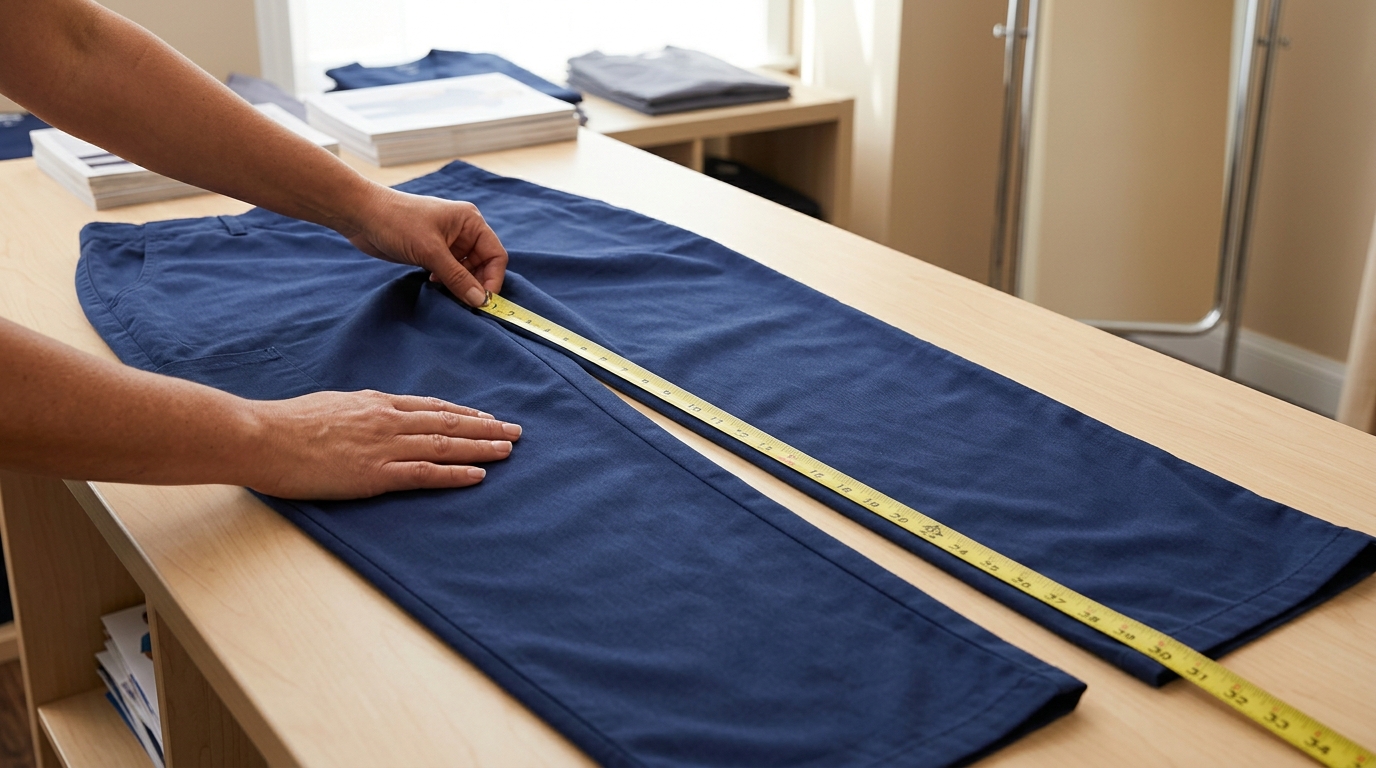
How to Measure a Garment Inseam
- Lay the pants flat.
- Smooth one leg without stretching it.
- Locate the crotch seam.
- Place a flexible measuring tape at that point.
- Follow the inner seam downward.
- Stop at the bottom of the hem.
- Record the measurement.
Compare this number with the published inseam for the scrub pants being considered.
Use a Similar Pant Style
The ideal inseam depends partly on silhouette.
A properly fitted:
- Jogger
- Tapered pant
- Straight-leg pant
- Flare pant
may each use a different finished length.
Do not use a cropped jogger as the only reference for determining the ideal straight-leg inseam.
Should You Measure Your Body or Your Pants?
Both can be useful, but an existing pair that fits well provides a particularly practical comparison.
It reflects:
- Preferred rise
- Preferred hem position
- Typical work shoes
- Personal fit preference
Body measurements are still important for choosing waist and hip size.
New Mexico State University’s guidance on measurements for fitting pants discusses multiple measurements, including the waist, hips, thigh, knee, and pant length, highlighting why lower-body fit depends on several dimensions rather than length alone.
What Is a Typical Tall Scrub Pant Inseam?
There is no universal number.
Tall inseams vary by:
- Manufacturer
- Collection
- Gender category
- Pant silhouette
- Intended fit
A tall jogger may intentionally use a different inseam than a tall straight-leg or flare pant.
Always use the actual product measurement instead of assuming that “tall” corresponds to one standard inseam.
How Should Tall Jogger Scrub Pants Fit?
Jogger scrub pants narrow toward the ankle and typically end with a fitted cuff.
The correct tall length scrub pants in a jogger silhouette should provide enough length for the cuff to sit naturally near the ankle without pulling the rest of the pant downward.
Correct Tall Jogger Fit
Look for:
- Cuff resting comfortably near the ankle
- Limited fabric stacking above the cuff
- Knee shaping aligned naturally
- Comfortable calf room
- Adequate thigh mobility
- Stable rise
Joggers That Are Too Short
Common signs include:
- Cuffs sitting unusually high
- Large amount of ankle exposed while standing
- Cuffs rising dramatically while sitting
- Pulling through the knee or thigh
- Pant leg appearing stretched vertically
Joggers That Are Too Long
Tall does not automatically mean correct.
A jogger may be too long when:
- Fabric stacks heavily above the cuff
- Lower legs bunch
- Knee area develops persistent folds
- Cuff sits below the intended ankle position
How Should Tall Tapered Scrub Pants Fit?
Tapered scrub pants gradually narrow toward the ankle but generally use a conventional hem rather than a cuff.
A well-fitted tall tapered pant should:
- Provide adequate thigh room
- Align naturally through the knee
- Narrow smoothly
- Avoid gripping the calf
- End neatly near the work shoe
If Tapered Pants Are Too Short
They may:
- Look unintentionally cropped
- Pull upward while sitting
- Place the narrowing too high on the leg
- Feel tight across the knee
If Tapered Pants Are Too Long
They may:
- Stack around the ankle
- Bunch behind the knee
- Look loose below the calf
- Lose the intended streamlined shape
The correct tall inseam should extend the leg without creating excess material.
How Should Tall Straight-Leg Scrub Pants Fit?
Straight-leg pants maintain a relatively consistent width through the lower leg.
Because there is no ankle cuff, the hem position becomes especially important.
A tall straight-leg pant should:
- Fall naturally toward the shoe
- Remain clear of the floor
- Avoid heavy stacking
- Avoid exposing excessive ankle
- Move freely during walking
Straight Pants That Are Too Short
They may:
- Finish too far above the shoe
- Rise significantly when sitting
- Look cropped despite not being designed that way
Straight Pants That Are Too Long
They may:
- Drag on the floor
- Fold beneath the heel
- Develop heavy ankle bunching
- Wear prematurely along the hem
How Should Tall Flare Scrub Pants Fit?
Flare or bootcut scrub pants become wider below the knee.
Tall flare styles require careful fitting because both knee position and hem length affect the final appearance.
The Flare Point
The widening should begin at the intended point relative to the knee.
If the pant is too short overall, the flare may start too high.
If the proportional pattern is too long, it may begin too low.
The Hem
A wide flare hem should remain safely clear of the floor.
Test the pants while wearing normal work shoes.
A tall flare that is slightly too long may:
- Drag
- Fold under the heel
- Fray
- Collect around the shoe
Do not assume extra length is always desirable just because the wearer is tall.
How Do Tall Cargo Scrub Pants Fit?
Cargo refers primarily to storage design.
Cargo pants can also be:
- Jogger
- Tapered
- Straight leg
- Relaxed
The position of the cargo pocket can help indicate whether the vertical proportions fit correctly.
Correct Cargo Pocket Placement
The pocket should generally:
- Sit comfortably on the thigh
- Remain above the knee
- Avoid the main bending point
- Stay easy to reach
- Remain comfortable while sitting
Cargo Pocket Too High
If regular scrub pants are proportionally too short, cargo pockets may sit higher on the thigh than intended.
A tall version may improve their placement.
Cargo Pocket Too Low
If tall pants add more proportional length than the wearer actually needs, the cargo pocket may move too close to the knee.
This is a sign that a long inseam alone may be preferable to a fully proportioned tall pattern.
Why Does Knee Placement Matter in Tall Scrubs?
The knee is one of the clearest indicators of vertical fit.
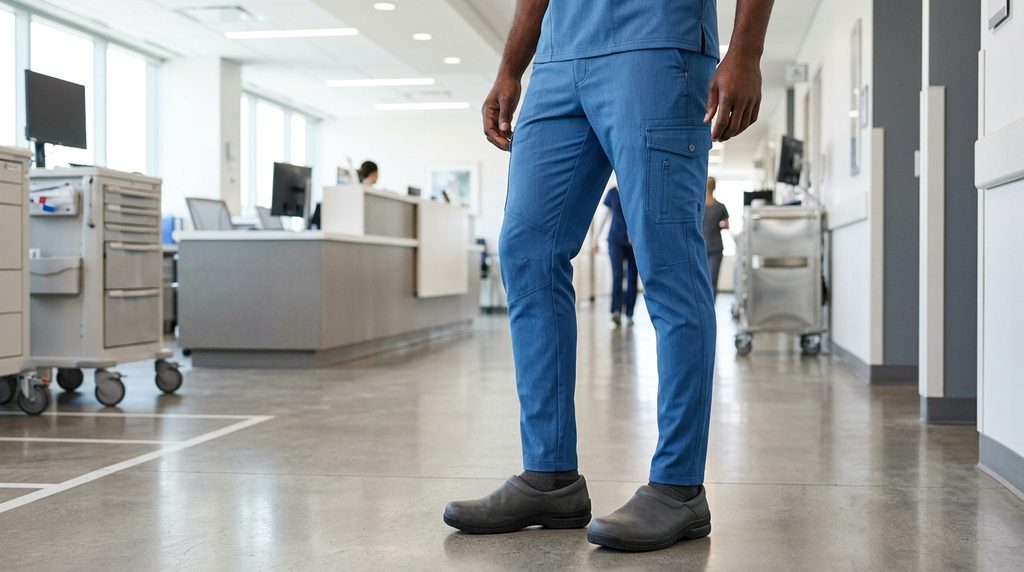
Knee placement matters particularly in:
- Joggers
- Tapered pants
- Cargo styles
- Articulated pants
- Flare designs
Knee Placement Too High
Possible signs include:
- Tightness while bending
- Lower leg appearing too long
- Taper starting too early
- Cargo pockets sitting too high
- Shaped seams pulling
This can occur when a wearer needs tall sizing but is wearing regular-length pants.
Knee Placement Too Low
Possible signs include:
- Bunching above the calf
- Taper starting too late
- Cargo pocket sitting near the knee
- Fabric folding while standing
This can happen when tall sizing is too long overall.
How Should Tall Scrub Pants Fit Through the Hips and Thighs?
Extra length should not require extra width unless the wearer also needs it.
The hips and thighs should provide enough room for:
- Sitting
- Walking
- Bending
- Raising the knee
- Taking a longer stride
Signs the Pants Are Too Tight
- Horizontal tension lines
- Front pockets pulling open
- Restricted seated movement
- Tightness through the thighs
- Side seams rotating
- Waistband pulled downward during movement
Signs the Pants Are Too Loose
- Excess seat fabric
- Large folds through the thighs
- Pants twisting during walking
- Pockets hanging away from the body
- Fabric collecting around the knees
If moving to tall sizing creates excess width, the wearer may need the same waist size in a longer inseam rather than a larger overall size.
How Should Men’s Tall Scrub Pants Fit?
Men may need additional attention to:
- Rise
- Seat
- Thigh
- Knee
- Calf
- Inseam
Professionals looking for men’s tall scrubs should choose based on actual lower-body proportions rather than simply selecting the tallest available size.
Men’s Straight-Leg Tall Scrubs
A straight-leg style may work well for men who want:
- More calf room
- Traditional styling
- A conventional hem
The hem should fall near the shoe without dragging.
Men’s Tall Joggers
Check:
- Thigh width
- Knee position
- Calf circumference
- Cuff position
- Rise
A tall jogger should solve leg-length issues without producing excessive fabric above the cuff.
Men’s Tall Cargo Scrubs
Cargo pocket position should align naturally with the thigh.
Loaded pockets should not cause the waistband to move downward.
How Does Body Shape Affect Tall Scrub Fit?
Tall individuals do not share one body shape.
Long Legs With Regular Torso Proportions
This wearer may primarily need:
- Longer inseam
- Regular rise
- Standard waist and hip proportions
Long Rise and Long Legs
A fully proportioned tall style may work better.
Long Thighs With Average Lower Legs
Tall sizing may place the hem correctly but create excessive length below the knee.
A different collection or custom alteration could work better.
Long Lower Legs
A pant with extra inseam but regular knee placement may provide a more natural fit.
Fuller Thighs
A slim tall jogger may still be restrictive.
A straight, relaxed tapered, or cargo style may provide better movement.
Fuller Calves
Narrow tall joggers can catch on the calf, making the pants appear shorter.
A straight or less aggressively tapered style may solve the issue.
Can Tight Thighs Make Regular Pants Look Too Short?
Yes.
When scrub pants are tight through the hips or thighs, the fabric may ride upward during movement.
This can make the hem appear shorter than the listed inseam suggests.
Signs include:
- Pant legs creeping upward
- Fabric tension across the thighs
- Horizontal pulling
- Pockets flaring outward
In this situation, switching immediately to tall sizing may not solve the problem.
A different cut or more thigh room may be necessary.
Can Tight Calves Make Pants Appear Too Short?
Yes.
A narrow jogger or tapered leg can catch around the calf instead of falling naturally.
The lower pant may then:
- Ride upward
- Bunch
- Expose more ankle
- Make the inseam appear insufficient
Check calf fit before deciding that additional length is needed.
Why Do Tall Scrub Pants Sometimes Bunch?
Tall pants can still be too long.
Bunching may occur because of:
- Excess inseam
- Rise that is too long
- Incorrect knee placement
- Loose thigh fit
- Tight calf fit
- Misaligned taper
- Poor fabric recovery
Bunching Behind the Knee
Some folding during sitting is normal.
Persistent bunching while standing can indicate an incorrect length or leg shape.
Bunching at the Ankle
This usually suggests:
- Excess inseam
- Too much lower-leg fabric
- A taper that does not match the calf
Bunching Through the Rise
This is more likely an upper-pant proportion problem than an inseam problem.
How Does Fabric Stretch Affect Tall Scrub Pants?
Stretch can improve comfort and mobility, but it does not replace correct proportions.
Useful stretch supports:
- Sitting
- Walking
- Bending
- Long strides
- Knee movement
Stretch Recovery Matters
Fabric should return reasonably close to its original shape after extension.
Poor recovery can lead to:
- Bagging knees
- Sagging seat
- Loose pocket openings
- Waistband distortion
A tall pant that loses shape through the day may begin to feel longer as the fabric sags.
What Fabric Features Matter Most?
Common scrub fabrics may contain:
- Polyester
- Cotton
- Rayon or viscose
- Nylon
- Spandex or elastane
The Federal Trade Commission provides guidance on textile fiber labeling, which explains fiber-content disclosure requirements for covered textile products.
Fiber content is only one consideration.
Also evaluate:
- Fabric weight
- Stretch direction
- Recovery
- Surface texture
- Drape
- Pocket support
- Care requirements
Two tall scrub pants with similar fiber percentages can feel and fit very differently.
Which Waistband Works Best for Tall Scrub Pants?
The best waistband depends on body proportions and pocket use rather than height.
Full Elastic
Provides consistent support around the waist.
Drawstring
Allows manual adjustment.
Elastic and Drawstring
Combines flexibility with additional security.
Wide Knit or Yoga-Style Waistband
Can spread pressure over a larger area.
Flat-Front Waistband
May provide a more tailored appearance.
Regardless of style, the waistband should remain stable because vertical fit cannot be evaluated correctly when the pants are continuously sliding.
How Do Pockets Affect Tall Scrub Pant Fit?
Pockets add weight and can alter the way pants hang.
Common pocket types include:
- Front slash pockets
- Back pockets
- Cargo pockets
- Zippered pockets
- Utility compartments
Heavy Pockets Can Pull Pants Downward
This may cause:
- Hem appearing longer
- Knee position shifting
- Rise dropping
- One leg hanging lower
- Waistband slipping
If a correctly fitted tall pant begins dragging only after the pockets are loaded, excessive pocket weight may be the real problem.
Pocket Placement Should Match Tall Proportions
Tall wearers may find that regular-length cargo pockets sit uncomfortably high.
A proportionally designed tall pant may position them more naturally.
Which Scrub Pant Style Works Best for Tall Healthcare Professionals?
There is no single best silhouette.
| Fit Priority | Style to Consider | Reason |
| Minimal ankle fabric | Tall jogger | Longer leg with controlled cuff |
| Streamlined fit | Tall tapered | Narrow lower leg without cuff |
| More lower-leg room | Tall straight leg | Conventional fit with calf space |
| Additional storage | Tall cargo | Thigh-level utility pockets |
| Wider lower leg | Tall flare | More room below knee |
| Relaxed silhouette | Tall wide leg | Additional overall leg room |
The final choice should also account for rise, waist, thigh, calf, and workplace requirements.
How Does Work Footwear Affect Tall Scrub Length?
Work shoes are essential to the fitting process.
Athletic Shoes
Tall jogger and tapered pants commonly pair well with athletic footwear.
Clogs
Straight and tapered pants should remain clear of the heel.
Slip-On Shoes
Check that the hem does not become trapped during walking.
Bulkier Work Shoes
Straight or subtle flare styles may provide additional space around the upper shoe.
Why Shoes Matter Most With Flare Pants
A flare hem fitted without work shoes may end up too long once the actual footwear is considered.
Always test conventional hems with shoes similar to those worn during a normal shift.
Should Tall Scrub Pants Touch the Floor?
No.
Additional length should provide proper proportions, not floor contact.
Straight, flare, and wide-leg scrub pants should remain clear of the floor during standing and walking.
Joggers generally finish around the ankle.
If tall scrub pants drag, investigate:
- Excess inseam
- Waistband slipping
- Rise that is too long
- Overall oversizing
- Incorrect footwear pairing
Do not keep excessive length simply because the garment is labeled tall.
How Much Should Tall Scrub Pants Rise When Sitting?
All pants move upward somewhat when the knees and hips bend.
The amount depends on:
- Leg shape
- Fabric
- Rise
- Inseam
- Knee construction
The important question is whether the movement appears excessive.
Possible Signs Pants Are Too Short
When seated:
- Straight hems rise far above their intended position
- Jogger cuffs travel unusually high
- Fabric pulls through the knee
- Rise becomes uncomfortable
Tall sizing may help when these issues occur together.
How Can Tall Scrub Pants Be Tested Before Buying?
A proper fitting should include several realistic movements.
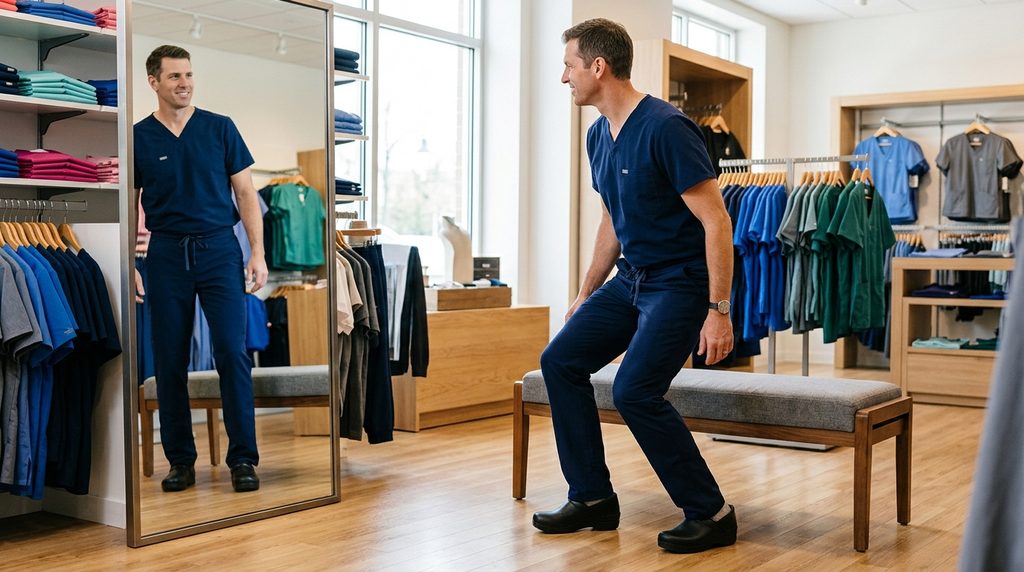
The Tall Scrub Pant Fit Test
Wear normal work underlayers and typical footwear.
Then:
- Stand naturally.
- Check waistband position.
- Check crotch position.
- Locate the knee shaping.
- Check pocket placement.
- Check hem or cuff position.
- Sit fully in a chair.
- Stand without adjusting the pants.
- Walk quickly.
- Raise one knee.
- Take several long steps.
- Bend at the knees and hips.
- Place normal lightweight items in the pockets.
- Recheck the waistband and hem.
Look for These Signs
The pants should not:
- Pull strongly through the rise
- Slide at the waist
- Restrict the thighs
- Position knees too high or low
- Catch tightly on the calves
- Expose excessive lower leg
- Drag on the floor
Healthcare professionals who want to compare regular and tall inseams before ordering several pairs can visit a medical scrub store in Lincoln to evaluate length, rise, knee placement, and footwear compatibility in person.
Regular vs Tall Scrub Pants: Which Should You Choose?
Choose regular length when:
- Hem falls correctly
- Knee placement is natural
- Rise fits
- Pockets sit correctly
- Sitting does not expose excessive lower leg
Consider tall length when regular pants:
- End consistently too high
- Rise substantially during sitting
- Position knee shaping too high
- Place cargo pockets too high
- Feel vertically compressed
Do not choose tall sizing when the real issue is tight thighs, tight calves, or incorrect rise.
Tall vs Larger Regular Size
These are not equivalent.
A larger regular size primarily adds circumference.
Tall sizing primarily addresses vertical dimensions.
Choose a Larger Size When:
- Waist is too tight
- Hips are too tight
- Thighs are too tight
- Pockets pull open
Choose Tall Length When:
- Waist and hips already fit
- Rise is acceptable
- Leg is consistently too short
- Knee and hem need additional vertical length
Separating size from length produces a more controlled fit.
Tall vs Regular Pants With Hem Alterations
Hemming can only make pants shorter.
It cannot create the extra length required by a tall wearer.
Regular pants that are too short cannot generally be lengthened significantly unless sufficient fabric was built into the original hem allowance.
Selecting the correct tall length from the beginning is typically more reliable.
What if Tall Pants Are Slightly Too Long?
If every other proportion fits correctly, professional hemming may be possible.
This works best with:
- Straight-leg pants
- Tapered pants
- Flare pants with enough room to preserve the silhouette
Joggers Are More Complicated
Jogger cuffs are integrated into the design.
Shortening may require:
- Removing the cuff
- Shortening the leg
- Preserving the taper
- Reattaching the cuff
Choosing the correct available inseam is preferable when possible.
How Should Tall Scrub Pants Be Bought Online?
Online shoppers should check:
- Waist measurement
- Hip measurement
- Front rise
- Back rise when available
- Inseam
- Thigh width
- Knee placement
- Leg opening
- Fabric composition
- Stretch
- Pocket placement
- Return policy
Compare With Known Pants
Measure a pair that already fits well.
Record:
- Waistband width
- Rise
- Inseam
- Thigh
- Leg opening
This creates a useful personal reference.
Review the Exact Style
Do not assume that the tall option for every garment has identical measurements.
A tall jogger and tall straight-leg pant may be designed with different inseams.
Order One Pair First
When trying a new collection:
- Order one pair.
- Keep tags attached.
- Test the fit at home.
- Wear normal shoes.
- Sit and walk.
- Check knees and pockets.
- Confirm the length before purchasing several pairs.
What if Tall Scrubs Are Long Enough but the Rise Is Wrong?
The problem may be the basic pant pattern rather than length.
Try:
- Another tall collection
- A different rise
- A different waistband
- A different leg silhouette
Someone may need:
- Tall inseam with mid rise
- Tall inseam with high rise
- Tall inseam with regular rise
The best combination depends on body proportions.
What if the Tall Inseam Fits but the Knees Are Too Low?
This suggests the pant’s overall vertical proportions may not match the wearer.
The person may have long lower legs but a more standard hip-to-knee distance.
A tall pattern that extends multiple areas can therefore feel misplaced.
Consider:
- Another manufacturer
- A regular-rise pant with a longer available inseam
- A different tall cut
- Professional alteration when appropriate
What if Regular Pants Fit Except for Ankle Exposure?
This is one of the strongest situations for trying a tall or extended inseam in the same size.
If the regular pant has correct:
- Waist
- Rise
- Hip fit
- Knee position
- Pocket placement
but the hem ends too high, additional inseam may solve the problem cleanly.
How Should Tall Scrub Pants Be Washed?
Always follow the garment’s care label and workplace procedures.
The Federal Trade Commission’s Care Labeling Rule requires covered apparel to provide regular care instructions.
Before washing:
- Empty all pockets
- Check hidden compartments
- Close zippers when instructed
- Follow wash-temperature guidance
- Observe bleach restrictions
- Use the recommended drying method
Why Care Matters for Tall Scrubs
Someone who needs nearly the full available tall inseam may notice even modest dimensional changes more than a wearer with extra length.
Improper laundering can potentially affect:
- Garment dimensions
- Elastic recovery
- Fabric texture
- Waistband performance
Choose a garment that fits before laundering rather than attempting to use shrinkage or stretching to correct the size.
Should Tall Scrub Pants Be Intentionally Stretched After Washing?
No general stretching method should be relied upon to create proper fit.
Manual stretching can distort:
- Fabric
- Waistbands
- Seams
- Knee shaping
- Pocket openings
Follow the care instructions instead.
If a pant does not provide adequate length before washing, a longer size or different style is more reliable.
How Can You Build a Tall Scrub Pant Rotation?
Once a reliable fit has been identified, record the details.
Save:
- Brand or collection
- Pant style
- Size
- Tall designation
- Actual inseam
- Rise
- Waistband
- Leg shape
- Fabric blend
- Pocket configuration
- Workplace-approved color
A practical work rotation might include:
- Everyday tall straight or tapered pants
- Tall joggers for reduced ankle fabric
- Tall cargo pants when extra storage is useful
- A backup pair
- A jacket or top that coordinates with the approved pants
Recording the actual inseam is more useful than remembering only the word “tall.”
Common Tall Scrub Pant Buying Mistakes
Choosing Tall Sizing Only Because of Height
Overall height does not determine leg proportions.
Buying a Larger Size for More Length
This can add unnecessary waist, hip, and thigh room.
Assuming Every Tall Inseam Is the Same
Measurements vary among garments.
Ignoring Rise
A longer inseam cannot correct an uncomfortable rise.
Ignoring Knee Placement
Tall proportions should place the knee correctly.
Choosing Maximum Length
More fabric is not automatically better.
Ignoring Calf Fit
A tight calf can make a correctly measured pant ride upward.
Ignoring Thigh Fit
Tight thighs can also make the pant appear too short.
Testing Only While Standing
Length problems may appear most clearly while sitting.
Forgetting Work Shoes
Footwear affects conventional hem placement.
Overloading Pockets
Heavy storage can pull the entire pant downward.
Buying Several Pairs Before Testing One
A small fit error becomes costly when repeated across an entire scrub rotation.
Tall Scrub Pant Fit Checklist
Waistband
- Stays at the intended position
- Does not roll
- Remains comfortable while sitting
- Does not slide when pockets are loaded
Rise
- Crotch sits naturally
- No pulling while seated
- No excessive sagging
- Appropriate coverage during bending
Hips and Thighs
- Pockets remain flat
- Sitting remains comfortable
- Long strides are unrestricted
- Fabric is not under constant tension
Knees
- Shaping aligns naturally
- Knee movement is unrestricted
- Taper begins at the correct point
Inseam
- Provides enough vertical length
- Does not create excessive stacking
- Remains appropriate while sitting
- Works with normal work shoes
Lower Leg
- Jogger cuffs sit naturally
- Taper does not grip calves
- Straight hems fall cleanly
- Flare hems remain clear of the floor
Pockets
- Cargo pockets sit naturally on the thigh
- Items remain accessible
- Pocket weight does not distort the pants
Conclusion
Tall scrub pants should solve a length problem without creating a width or proportion problem.
The correct pair should provide enough inseam while keeping the:
- Waistband secure
- Rise comfortable
- Hips and thighs properly fitted
- Knees correctly positioned
- Pockets accessible
- Leg shape proportional
- Hem safely positioned around footwear
The most important principle is to separate size from length.
If regular scrub pants fit through the waist and hips but consistently finish too high, a tall version in the same general size may be the appropriate solution. If the thighs, calves, or rise are also uncomfortable, the problem may involve the cut rather than inseam alone.
Tall sizing works best when it follows the wearer’s real proportions instead of simply adding the maximum amount of fabric available.
Frequently Asked Questions
What is considered a tall inseam for scrub pants?
There is no universal tall inseam. The measurement varies by manufacturer, collection, gender category, and pant style. Check the specific garment’s size chart and compare it with a well-fitting pair of work pants.
How do I know if I need tall scrub pants?
Tall sizing may help when regular pants fit correctly at the waist and hips but consistently end too high, rise excessively while sitting, or place knee shaping higher than your natural knee.
Should tall people always wear tall scrub pants?
No. A tall person may have a longer torso and regular-length legs. Inseam, rise, knee placement, and overall body proportions are more useful than total height.
Are tall scrub pants wider than regular pants?
Tall sizing is intended primarily to add vertical length, although exact pattern changes vary by manufacturer. Choosing a larger numerical size to gain length may add unnecessary width through the waist, hips, and thighs.
Why are my regular scrub pants too short when I sit?
Sitting bends the hips and knees, naturally pulling pant legs upward. If regular pants rise excessively, the inseam may be too short or the rise, thigh, or calf fit may be restricting movement.
Should tall jogger scrub pants cover the ankle?
Jogger cuffs generally sit around the ankle rather than covering the shoe. They should remain comfortable while standing and should not rise excessively high when seated.
Can tall scrub pants be hemmed?
Straight, tapered, and flare tall pants can often be hemmed when every other proportion fits correctly. Joggers are more complicated because shortening them may require removing and reattaching the cuff.
Are tall scrub pants only for men?
No. Tall sizing can be useful for any healthcare professional who needs additional leg length or taller lower-body proportions. Actual availability varies by collection.