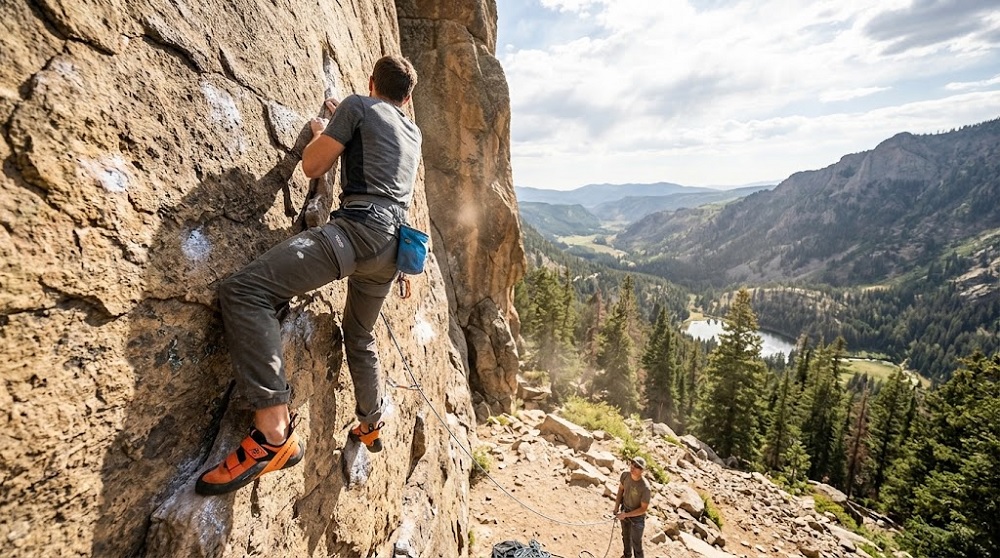
If you’ve ever tried on a pair of rock climbing shoes and found them oddly loose in the heel or cramped across the toe box, the category you picked might be the reason.
Rock climbing shoes mens models aren’t just relabeled versions of women’s shoes. The lasts (the molds used to shape the shoes), the volume, and even the downturn angles are often different, and those differences show up on the wall.
Here’s what you need to know before you buy.
What “last shape” means and why it matters
A last is the 3D foot form that a shoe is built around. Climbing shoe companies use different lasts for men’s and women’s models because male and female feet tend to have different proportions, even at the same length.
Men’s lasts are generally:
- Wider across the forefoot
- Narrower in the heel relative to foot length
- Built for a higher volume foot overall
Women’s lasts tend to be:
- Narrower in the forefoot
- Wider and more tapered in the heel
- Lower volume, meaning less internal space throughout the shoe
When you put a male foot into a women’s last, the toe box feels tight and the forefoot gets compressed. When a female foot goes into a men’s last, there’s often dead space in the heel and across the top of the foot, which kills sensitivity and precision.
Volume differences: more than just length and width
Volume is the total internal space of the shoe. Two shoes can be the same length and still feel completely different because one has more depth across the instep or more room around the ankle collar.
Men’s models typically have higher volume to account for a thicker foot profile. Women’s models are lower volume, with a closer fit through the instep and ankle.
This matters most in two situations:
Slab climbing. On low-angle slab, you need your foot to feel the rock directly. Extra volume creates a dead zone between your foot and the sole. You lose feedback.
Precision edging. When you’re standing on a 5mm edge, any movement inside the shoe transfers force in the wrong direction. A low-volume shoe that fits your foot shape keeps things stable.
How the toe box shape differs
Beyond volume, the toe box geometry varies between men’s and women’s models.
Women’s shoes often have a slightly more tapered toe box to match a narrower forefoot. Men’s shoes tend to have a boxier, wider toe profile.
If you have a narrow foot and you’re buying men’s shoes, the toe box might force your toes into an unintended splay. That doesn’t just feel uncomfortable. It can affect how your foot loads the shoe on small holds.
Downturn and asymmetry
Most performance climbing shoes have a downturned shape (the toe points down when you hold the shoe flat) and an asymmetric design (the shoe curves toward the big toe).
The degree of asymmetry and downturn is usually the same between men’s and women’s versions of the same shoe model. But the last shape means the asymmetry sits differently on each foot type.
On a men’s last, the pivot point of the asymmetry tends to align with a wider forefoot. On a women’s last, it’s calibrated for a narrower profile. If your foot shape doesn’t match the last, the asymmetry pulls your toes in the wrong direction, which affects how you load pockets and edges.
What happens when you buy the wrong category
Buying the wrong category isn’t just about comfort. It affects how you climb.
Here’s what goes wrong:
- Heel slippage: Too much volume in the heel means the shoe moves when you heel hook. You lose power transfer and risk the shoe pulling off mid-move.
- Toe cramping: A forefoot that’s too narrow forces your toes to overlap or curl in ways that weren’t intended by the shoe’s design, increasing discomfort and reducing sensitivity.
- Dead spots on the sole: When internal volume doesn’t match foot volume, parts of the sole don’t make full contact with your foot. You feel less of what’s happening on the rock.
- Faster wear: Shoes that don’t fit the right last tend to wear unevenly because the pressure distribution is off.
Should men ever buy women’s climbing shoes?
Some men with narrow, low-volume feet find women’s models fit them better than men’s models. This is especially common with men who have slender feet and struggle to get a snug heel fit in standard men’s lasts.
If you fall into that category, it’s worth trying women’s models in a size up (roughly one full size, since women’s sizing runs smaller). The fit, not the label, is what matters.
The same goes the other way. Women with wider feet or higher volume sometimes fit better in men’s models.
How to find the right fit regardless of category
A few practical things to check when trying on climbing shoes:
- Your toes should be touching the front of the shoe but not painfully curled (for performance shoes) or flat (for beginner shoes)
- The heel cup should feel snug with no dead space
- The shoe should feel tight across the top of the foot without any gap at the instep
- You shouldn’t feel the sides of the shoe pressing unevenly on one part of your foot
Try both men’s and women’s versions of the same model if the brand makes both. Some brands, like La Sportiva and Scarpa, offer gender-specific versions of the same performance shoe. Others, like Evolv, offer unisex models on a single last.
FAQ
Do men’s and women’s climbing shoes use the same rubber?
Generally yes. The rubber compound on the sole is usually the same between men’s and women’s versions of the same model. The difference is in the last shape and volume, not the sole material.
Can I convert between men’s and women’s sizing for climbing shoes?
A rough conversion is one full size. Women’s 8 is close to men’s 7, for example. But because the last shapes are different, size alone won’t tell you whether the shoe will fit properly. You need to try both categories.
Why do women’s climbing shoes sometimes cost less than men’s?
They usually don’t. Pricing is almost always the same between gendered versions of the same model. If you see a price difference, it’s probably a sale or a stock issue, not a structural pricing difference.
Do beginner climbing shoes differ as much between men’s and women’s as performance shoes do?
The category differences still exist in beginner shoes, but they matter less because beginner shoes have more internal volume and softer construction overall. As you move into intermediate and performance models, the last precision increases and fit differences become more noticeable.
What brands make the best men’s climbing shoes for narrow feet?
La Sportiva, Scarpa, and Five Ten all offer models with narrower lasts in their men’s range. The La Sportiva Mythos and the Scarpa Vapor V are two commonly recommended options for men with narrow feet. That said, trying shoes in person beats reading specs online.
Is it worth getting climbing shoes resoled if the last fit is wrong?
Resoling replaces the rubber, not the last shape. If the shoe doesn’t fit your foot correctly, resoling won’t fix that. It only makes sense to resole shoes that fit you well but have worn-out soles.