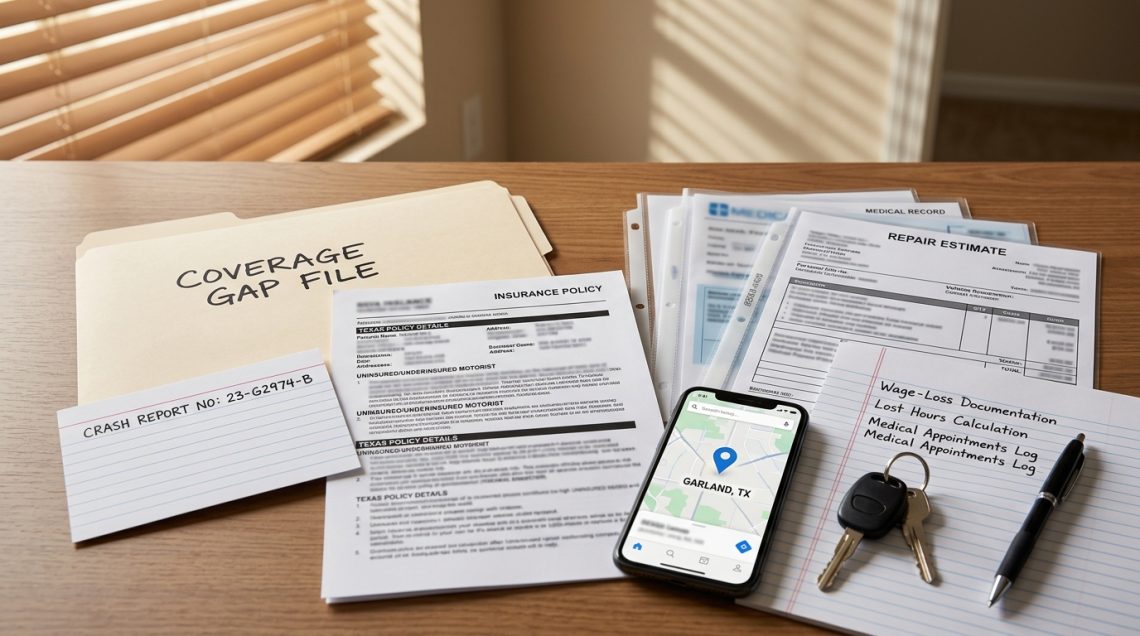
A car accident is stressful enough. It becomes even more frustrating when the driver who caused the crash has no insurance, not enough insurance, or cannot provide valid proof of coverage.
In Texas, an uninsured driver accident can create a coverage gap. Your medical bills, vehicle repairs, rental costs, lost wages, and out-of-pocket expenses may still exist, but the at-fault driver may not have an insurance company ready to pay them.
This guide explains what to do after an uninsured driver accident in Texas, what coverage may apply, what records to save, and when legal guidance may be useful.
Quick Answer
After an accident with an uninsured driver in Texas, call police when needed, get medical care, exchange information, photograph the scene, collect witness details, track the crash report, notify your own insurance company, review your policy for uninsured/underinsured motorist coverage, collision coverage, personal injury protection, medical payments coverage, and rental coverage, and save all medical, repair, wage, and insurance records.
If you were injured in Garland or the insurer disputes coverage, fault, medical bills, or settlement value, speaking with an auto accident attorney Garland residents can contact may help you understand what evidence matters, what policy benefits may apply, and what Texas deadlines could affect your claim.
Key Takeaways
- An uninsured driver accident creates a coverage gap because the at-fault driver may not have liability insurance available to pay for injuries or damage.
- Your own insurance may become important, especially uninsured/underinsured motorist coverage, collision coverage, personal injury protection, medical payments coverage, or rental reimbursement.
- Texas drivers are required to carry minimum liability coverage, but some drivers still drive without insurance or with too little coverage.
- Important records may include crash reports, scene photos, medical bills, repair estimates, insurance messages, witness details, wage records, and policy documents.
- Texas deadlines and shared-fault rules can affect uninsured driver claims.
The Coverage Gap Problem
Most car accident claims begin with a basic assumption: the at-fault driver has insurance. When that assumption fails, the injured person may face immediate questions.
Who pays for the emergency room visit? Who pays for vehicle repairs? What if you cannot work? What if your car is totaled? What if the other driver gave old, fake, canceled, or invalid insurance information? What if they simply admit they have no coverage?
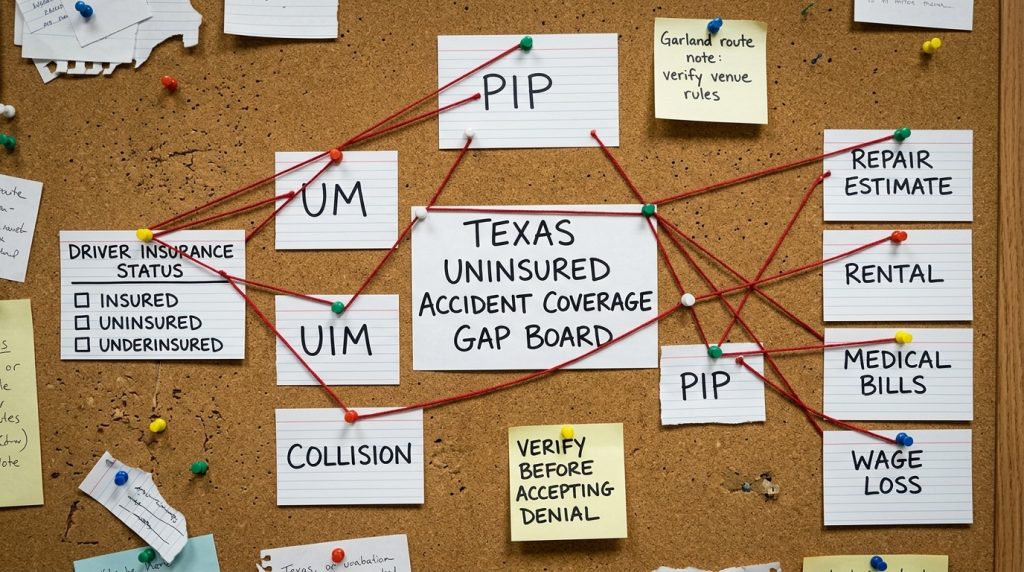
An uninsured driver claim often requires several layers of review:
- The crash facts
- The other driver’s insurance status
- Your own insurance policy
- Available UM/UIM coverage
- Collision coverage
- PIP or medical payments coverage
- Health insurance coordination
- Repair and rental coverage
- Medical records
- Lost wage proof
- Texas deadlines
- Fault disputes
The goal is to identify every possible path of recovery before accepting a quick answer from any insurer.
What Counts as an Uninsured Driver Accident?
An uninsured driver accident may involve more than a driver who openly says, “I do not have insurance.”
Common uninsured or coverage-gap situations include:
- The at-fault driver has no auto insurance.
- The at-fault driver’s policy was canceled before the crash.
- The driver gave expired or invalid insurance information.
- The vehicle owner has coverage, but the driver may not be covered.
- The at-fault driver was excluded from the policy.
- The insurer denies coverage after investigation.
- The driver left the scene and cannot be identified.
- The driver has insurance, but the policy limits are too low for the damages.
- Multiple injured people are competing for limited policy funds.
Some of these situations are uninsured motorist issues. Others may be underinsured motorist issues. The difference matters because different policy benefits, deductibles, documentation rules, and insurance positions may apply.
Texas Minimum Insurance and Why It May Not Be Enough
Texas requires drivers to carry minimum liability coverage. The commonly cited minimum amounts are:
- $30,000 for bodily injury or death of one person in one crash
- $60,000 total for bodily injury or death of two or more people in one crash
- $25,000 for property damage in one crash
These minimum limits may not be enough after a serious crash. A single emergency room visit, ambulance bill, surgery, imaging, therapy, vehicle total loss, rental costs, and missed work can quickly exceed minimum coverage.
That is why uninsured and underinsured motorist coverage can be important. It may help when the other driver has no insurance, not enough insurance, or cannot be found after a hit-and-run.
What To Do First After an Accident With an Uninsured Driver
The first steps after a crash are similar whether the other driver is insured or uninsured, but documentation becomes even more important when coverage is missing.
1. Move to Safety and Check for Injuries
If possible, move out of active traffic. Turn on hazard lights. Check yourself, passengers, and others for injuries.
Call 911 if:
- Anyone is hurt
- A vehicle cannot be moved
- Traffic is blocked
- A driver leaves the scene
- A driver appears impaired
- The other driver has no insurance
- The crash caused serious damage
- There is a dispute about what happened
2. Exchange Information
Collect:
- Driver name
- Phone number
- Driver’s license information
- License plate number
- Vehicle make, model, and color
- Insurance information, even if the driver says it may be expired
- Vehicle owner information
- Passenger names, if available
If the other driver has no insurance, write that down. Do not argue at the scene.
3. Photograph the Scene
If safe, take photos of:
- Vehicle damage
- License plates
- Road layout
- Traffic signs and signals
- Skid marks or debris
- Final vehicle positions
- Weather and lighting
- Visible injuries
- Nearby cameras
- Damaged personal property
4. Collect Witness Details
Ask witnesses for names and phone numbers. This may include other drivers, passengers, pedestrians, store employees, apartment staff, parking-lot attendants, or nearby residents.
5. Get Medical Care
Do not delay care because the other driver lacks insurance. Your health comes first, and medical records help document the injury timeline.
Garland and North Texas Accident Context
Although this guide applies statewide, uninsured driver accidents in Garland may happen in many local settings.
Common Garland-area crash contexts may include:
- I-30
- I-635
- President George Bush Turnpike
- SH 78
- Garland Road
- Lavon Drive
- Centerville Road
- Northwest Highway
- Broadway Boulevard
- Forest Lane
- Firewheel-area retail routes
- Downtown Garland
- Apartment entrances
- Grocery store parking lots
- Gas stations
- School traffic zones
- DART-adjacent travel areas
- Industrial and delivery corridors
- Neighborhood intersections
The location matters because it may affect available evidence. A freeway crash may involve dashcam footage, tow records, and multi-vehicle witnesses. A parking-lot crash may involve store cameras, property incident reports, and photos of vehicle positions. A hit-and-run or no-insurance crash near an apartment complex may involve gate cameras, doorbell footage, or witness statements.
Crash Reports and Insurance Documentation
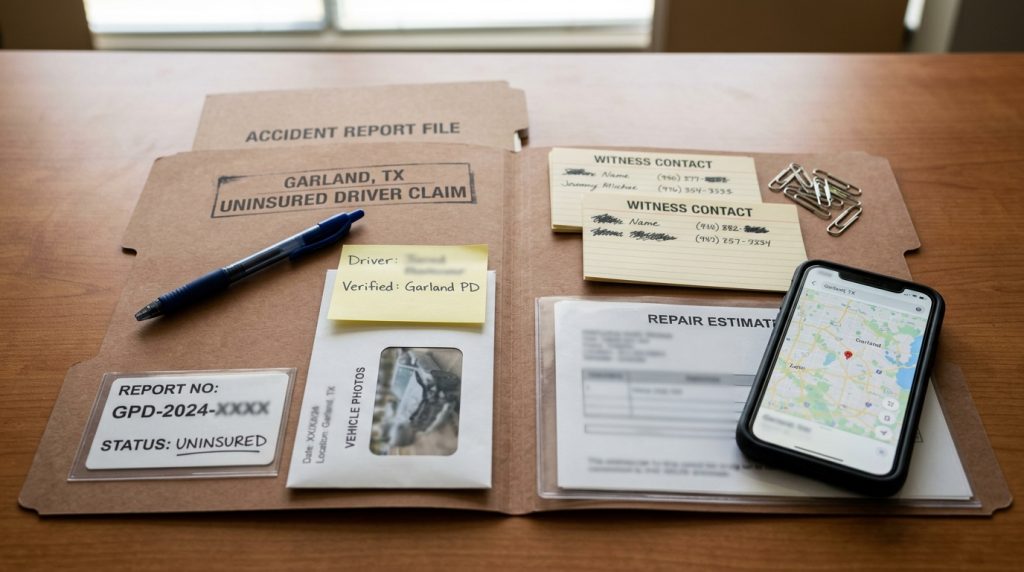
A crash report may become an important record after an uninsured driver accident. It can document the date, location, drivers, vehicles, insurance information, reported injuries, witness details, citations, and officer observations.
For Garland crashes, the Garland Police Department’s reports and links page includes a TxDOT Crash Reports link. TxDOT maintains crash report resources for Texas crashes submitted by law enforcement agencies.
Save:
- Crash report number
- Responding agency
- Officer name, if known
- Crash date
- Crash location
- Driver information
- Vehicle information
- Insurance information listed
- Witness names
- Citation information
- Notes about whether the other driver lacked valid coverage
A crash report is helpful, but it is not the whole claim. Photos, videos, witness statements, medical records, insurance messages, and repair documents may also matter.
Your Own Insurance May Become the Main Recovery Path
When the at-fault driver has no insurance, your own policy may matter more than expected. Review the declarations page and policy language carefully.
Possible coverage sources may include:
Uninsured Motorist Coverage
Uninsured motorist coverage may apply when the at-fault driver has no insurance or when a hit-and-run driver cannot be found, depending on the policy and facts.
Underinsured Motorist Coverage
Underinsured motorist coverage may apply when the at-fault driver has some insurance, but not enough to cover the full injury or damage claim.
Collision Coverage
Collision coverage may help pay for vehicle repairs or total-loss damage, regardless of whether the at-fault driver has insurance, subject to the policy deductible and terms.
Personal Injury Protection
Personal injury protection may help with medical bills and certain other losses, depending on the policy. Texas policies may include PIP unless rejected in writing.
Medical Payments Coverage
Medical payments coverage may help with medical expenses, depending on policy terms.
Rental Reimbursement
Rental coverage may help with transportation while the vehicle is being repaired or while a total-loss issue is being handled, depending on the policy.
Health Insurance
Health insurance may help pay medical bills, but reimbursement rights, liens, deductibles, and coordination issues may need to be reviewed.
Do not rely only on what an adjuster says in a phone call. Ask for written explanations and keep copies of all policy pages, claim letters, and payment decisions.
UM/UIM Coverage: What Questions Should You Ask?
Uninsured and underinsured motorist claims can be confusing because you may be making a claim through your own insurance company, but still proving that another driver caused the crash.
Ask these questions:
- Do I have UM bodily injury coverage?
- Do I have UIM bodily injury coverage?
- Do I have UM/UIM property damage coverage?
- What are the policy limits?
- What deductible applies?
- Does coverage apply to a hit-and-run?
- What proof does the insurer require?
- Does the policy require prompt notice?
- Does the insurer require a police report?
- Can the insurer dispute fault?
- Can the insurer dispute medical bills?
- Can the insurer require a recorded statement?
- What documents are needed before evaluation?
- Are there deadlines in the policy?
UM/UIM coverage can be valuable, but it does not mean the insurer will automatically pay everything requested. Documentation still matters.
Insurance Disputes After an Uninsured Driver Crash
Insurance disputes may arise even when you paid for your own coverage.
Common disputes include:
- The insurer says UM/UIM coverage was rejected.
- The insurer says the other driver was not actually uninsured.
- The insurer says the crash facts are unclear.
- The insurer disputes fault.
- The insurer says injuries are unrelated.
- The insurer questions treatment gaps.
- The insurer disputes medical bills.
- The insurer disputes vehicle repair costs.
- The insurer says the claim exceeds policy limits.
- The insurer requests broad medical authorizations.
- The insurer asks for a recorded statement.
- The insurer delays while investigating coverage.
- The insurer makes a low settlement offer.
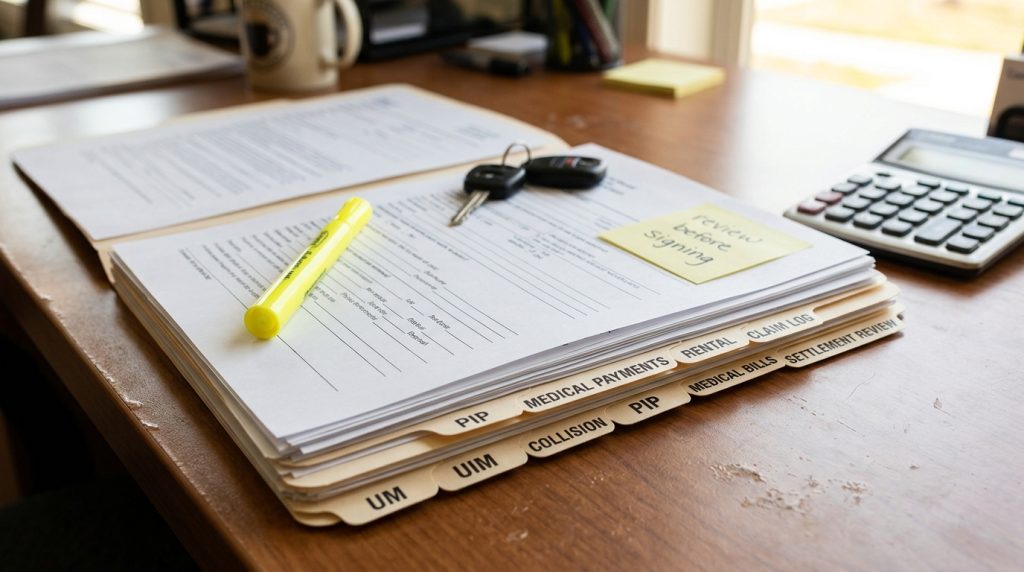
A well-organized file can help answer these disputes with records instead of memory.
What If the Other Driver Has No Insurance and No Money?
An uninsured at-fault driver may still be legally responsible for the harm caused. But collecting money directly from an uninsured person can be difficult if they do not have assets, income, or collectible resources.
That is why policy review is so important.
Potential recovery paths may include:
- Your own UM/UIM coverage
- Collision coverage
- PIP coverage
- Medical payments coverage
- Health insurance
- Claims against another responsible party
- Claims involving vehicle ownership
- Claims involving an employer, if the driver was working
- Claims involving a commercial vehicle or rideshare company
- Claims involving unsafe roadway or property conditions in limited situations
The key question is not only whether the uninsured driver caused the crash. It is whether any coverage or additional responsible party exists.
What If the Driver Was Borrowing Someone Else’s Car?
Coverage can become more complicated when the uninsured driver was using someone else’s vehicle.
Questions may include:
- Who owned the vehicle?
- Did the owner give permission?
- Did the owner have insurance?
- Was the driver excluded from the policy?
- Was the vehicle used for work?
- Was the driver delivering food, packages, or passengers?
- Was a company, rideshare platform, or employer involved?
- Was the vehicle stolen?
Do not assume there is no coverage just because the driver says they were uninsured. Vehicle owner coverage, employer coverage, commercial coverage, rideshare coverage, or your own policy may still need review.
What If the Crash Was a Hit-and-Run?
A hit-and-run creates a different kind of uninsured driver issue because the driver cannot be identified. Your own UM/UIM coverage may become important if the other driver cannot be found.
After a hit-and-run:
- Do not chase the fleeing driver.
- Move to safety.
- Call police.
- Write down vehicle details immediately.
- Photograph damage and the scene.
- Collect witness information.
- Look for nearby cameras.
- Notify insurance promptly.
- Save repair and medical records.
Useful details may include vehicle color, make, model, body style, full or partial plate, direction of travel, visible damage, and distinctive features.
Medical Records and Lost Wage Proof
Medical records are central to uninsured driver claims because they help show what injuries were caused by the crash.
Save records from:
- Emergency medical services
- Emergency rooms
- Urgent care clinics
- Primary care doctors
- Orthopedic specialists
- Neurologists
- Imaging centers
- Physical therapy providers
- Pharmacies
Also save:
- Medical bills
- Prescription receipts
- Imaging reports
- Discharge instructions
- Referral paperwork
- Work restriction notes
- Follow-up appointment records
- Therapy attendance records
If you missed work, save:
- Pay stubs
- Timesheets
- Employer letters
- Missed-shift confirmations
- Contractor invoices
- Tax records
- Work restriction notes
- Notes about reduced hours or changed duties
Insurance companies often review treatment timelines closely. Delayed care, missed appointments, or unclear records may create disputes.
Vehicle Repairs, Rentals, and Total Loss Issues
When the at-fault driver has no insurance, property damage may depend on your own policy.
Save:
- Photos of vehicle damage
- Repair estimates
- Supplemental estimates
- Body shop invoices
- Total-loss valuation paperwork
- Rental car receipts
- Towing receipts
- Storage bills
- Personal property damage receipts
- Child seat replacement information, if relevant
- Communications with repair shops and insurers
If your vehicle is declared a total loss, ask how the insurer calculated the value. Keep valuation reports, comparable vehicle information, payoff records, title documents, and all written communications.
Texas Deadlines and Shared-Fault Rules
Texas personal injury claims are time-sensitive. In many cases, a person must bring a personal injury lawsuit within two years after the day the cause of action accrues under Texas Civil Practice and Remedies Code Section 16.003.
That does not mean you should wait. Evidence can disappear quickly. Vehicles may be repaired, witnesses may become difficult to locate, camera footage may be erased, and insurance-policy deadlines may apply.
Texas law can also affect claims when fault is disputed. Under Texas Civil Practice and Remedies Code Section 33.001, a claimant may not recover damages if their percentage of responsibility is greater than 50%.
Even when the other driver has no insurance, your own insurer may still dispute fault. It may argue that you were speeding, distracted, following too closely, failed to avoid the crash, delayed medical care, or gave inconsistent statements.
Evidence matters because coverage alone does not prove damages.
When Legal Guidance May Be Useful
Not every uninsured driver claim requires legal help. But legal guidance may be useful when the accident involves injury, denied coverage, disputed fault, low offers, or unclear insurance benefits.
Consider speaking with a lawyer if:
- You were injured
- You needed emergency care
- Medical treatment is ongoing
- The other driver had no insurance
- The other driver gave invalid insurance information
- The insurer says UM/UIM coverage does not apply
- The insurer disputes fault
- The insurer disputes medical bills
- The insurer delays or denies the claim
- The crash involved a hit-and-run
- The crash involved a commercial vehicle, rideshare driver, or delivery driver
- You missed work
- Your vehicle was totaled
- The settlement offer seems too low
- A loved one suffered a fatal injury
A lawyer may help preserve evidence, review available coverage, communicate with insurers, evaluate damages, and explain Texas deadlines.
Mistakes to Avoid After an Uninsured Driver Accident
Avoid these common mistakes:
- Leaving without reporting the crash
- Failing to get the other driver’s information
- Not photographing the scene
- Waiting too long to seek medical care
- Assuming there is no coverage
- Failing to review your own policy
- Missing insurance notice requirements
- Giving broad recorded statements
- Guessing about speed, distance, timing, or injuries
- Signing broad medical authorizations
- Accepting a quick settlement before treatment is complete
- Repairing the vehicle before documenting damage
- Throwing away damaged property
- Ignoring policy letters
- Waiting too long to ask about deadlines
Small mistakes can make an uninsured driver claim harder to prove.
Texas Uninsured Driver Accident Checklist
Use this checklist to organize the claim:
- Move to safety
- Call 911 when needed
- Get medical care
- Exchange driver and vehicle information
- Document that the other driver lacks valid insurance, if known
- Take scene and damage photos
- Collect witness names and phone numbers
- Look for nearby cameras
- Save the crash report number
- Notify your own insurer
- Ask whether UM/UIM coverage applies
- Ask whether collision coverage applies
- Ask whether PIP or medical payments coverage applies
- Save medical records and bills
- Save repair estimates and rental receipts
- Track missed work and out-of-pocket expenses
- Keep all insurance letters and emails
- Avoid signing a release too quickly
- Ask about Texas deadlines early
FAQ
Move to safety, call 911 when needed, get medical care, exchange information, take photos, collect witnesses, track the crash report, notify your insurer, and review your own policy for UM/UIM, collision, PIP, medical payments, and rental coverage.
Yes. Texas requires drivers to carry minimum motor vehicle liability insurance. However, some drivers still drive without insurance, with expired policies, or with too little coverage.
Uninsured motorist coverage may help when the at-fault driver does not have liability insurance or when a hit-and-run driver cannot be found, depending on the policy and facts.
Underinsured motorist coverage may help when the at-fault driver has liability insurance, but not enough to cover the full amount of injuries or damages.
Not necessarily. Your insurer may still review fault, coverage, medical records, vehicle damage, policy terms, deadlines, and documentation before paying.
If UM/UIM coverage was rejected in writing, it may not be available under that policy. Ask for a copy of the rejection form and review the policy documents carefully.
Possibly. But collecting money directly from an uninsured driver can be difficult if the person has limited assets or income. Insurance coverage and other responsible parties should also be reviewed.
Vehicle owner coverage, permissive use, exclusions, employer coverage, rideshare coverage, or commercial coverage may need to be reviewed. Do not assume there is no coverage based only on what the driver says.
Important evidence may include the crash report, driver information, insurance status, photos, witness details, medical records, repair estimates, wage proof, policy documents, and insurance communications.
In many Texas injury cases, the general deadline is two years from when the cause of action accrues. Some claims may involve shorter notice rules or insurance-policy deadlines.
No. This article is for general informational purposes only. Anyone dealing with a specific uninsured driver accident claim should speak with a qualified legal professional about their situation.
Final Thoughts
An uninsured driver accident in Texas can create a stressful coverage gap. The other driver may be responsible, but responsibility alone does not pay medical bills, repair costs, rental expenses, or lost wages.
The strongest next step is organization. Get medical care, document the crash, track the report, review your own policy, save insurance messages, preserve proof of losses, and ask about Texas deadlines before too much time passes.